


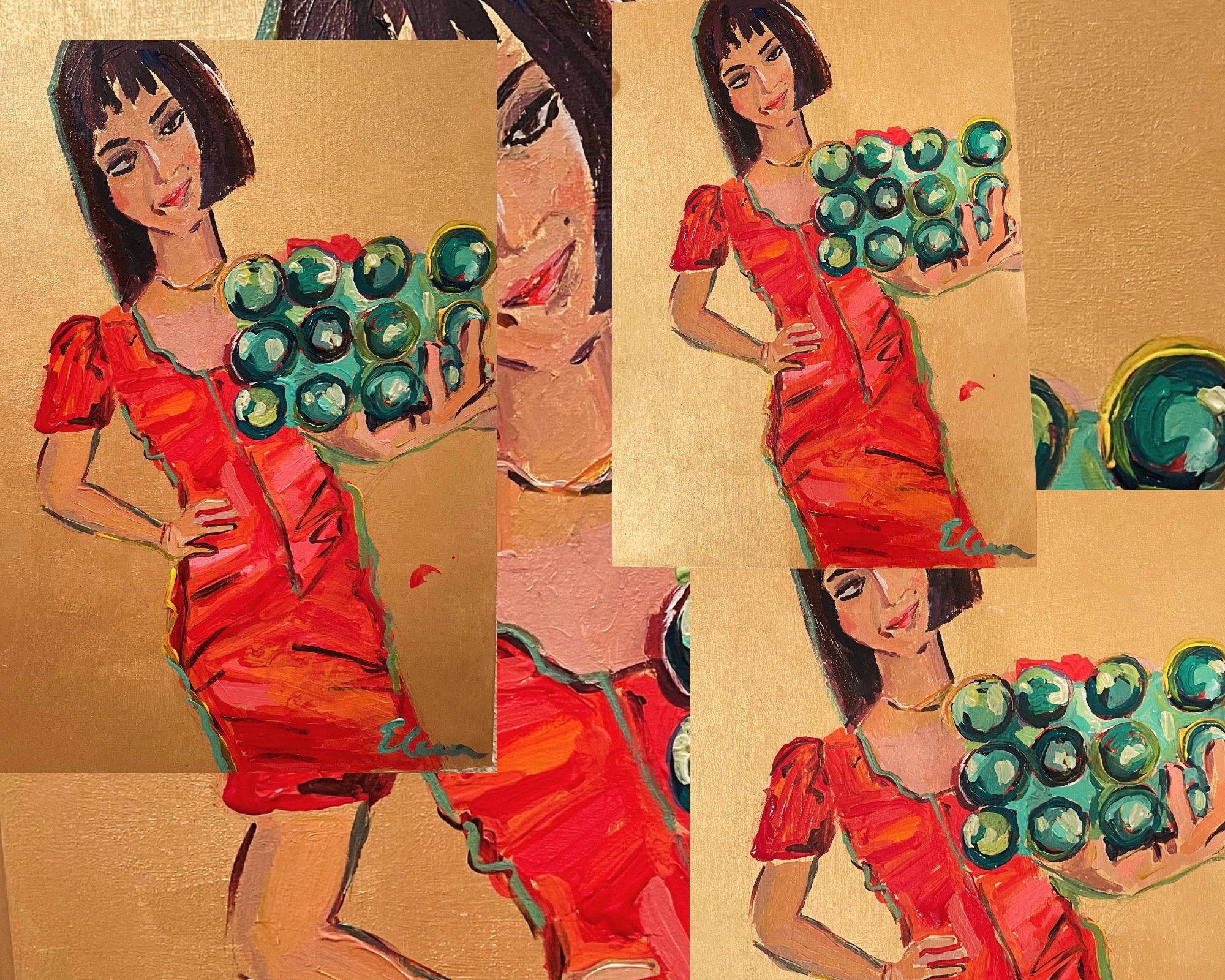


In which I stumble upon a post-Christmas sale at one of my favorite stores and treat myself to a red dress and an interesting clutch because I want to be more like Miss Vulpe. Which is kind of meta considering I invented Miss Vulpe in the first place – complete with her sense of style and her penchant for fine living. In channeling her I’m channeling myself. Deconstruction. Reconstruction. And other postmodern crap. Which I happen to love. I’m all about postmodernism, discourse, identities, etc.
It’s actually what my new novel, Magic Lessons for Margo is all about. My reasoning for writing it was my desire to play with different perspectives. Characters don’t only get to explore their identities, they also serve as lenses to see each other through. I like to play with both intimacy and othering – characters revealing their deepest feelings and thoughts, but also being observed from a distance.
Margo, of course, is the main character, but at first appears to be just a a vehicle for her sister’s protagonism. Margo is there as an observer of Ana and her secrets. But gradually, Margo learns that she herself is a woman with an interesting story, a true protagonist who makes her own choices and goes after what she wants – which goes deeper than a desire to understand her sister or her mother. Margo has wants of her own. She wants to explore her universe, real and imaginary, she wants a connection with certain people, she wants a career that suits her intellectual curiosity, and she wants a romance with someone who just happens to be a girl. Margo is the first LGBTQ main character I wrote (I do have other LGBTQ characters in other novels, but they’re not the MC). It’s how the story unfolded in my imagination, and it made sense for her to be a young woman in need of a better understanding of her own identity. My beta readers helped immensely with rendering her perspective as a character figuring out her sexuality.
While Margo is a young woman just now discovering who she is attracted to, Miss Vulpe, her younger sister, is a prematurely emancipated girl who relishes her power over men – yet regrets some of the sexual manipulation she’s engaged in in the past. Her story, however, is not revealed to the reader immediately nor directly. She’s only seen through Margo’s perspective, and the reader has access to her intimate world only as it becomes known to Margo.
A third character in the story addresses the reader directly, occasionally stealing the spotlight and becoming a secondary MC, yet this character seems remote too for a rather eerie reason: She is dead. In her Notes form the Other Side, Margo’s mother, Louise, becomes alternately relatable and completely puzzling. In the end, her story is one the girls have to piece together, being mindful that, in true postmodern fashion, the narrative changes depending on who controls it. Because she’s not here to tell it, their mother’s story can easily be hijacked, simplified, transformed. The girls equate these incomplete tellings to an imprisonment of sorts, the metaphorical madwoman locked in the attic. Yet in the end, all they themselves have to know their mother by are incomplete narratives filtered through the perspectives of two men who disappointed her.
You might wonder, which of these characters is me. As usual, none and all. Miss Vulpe is probably the one I relate to the most. But I love Margo, and enjoyed writing from her perspective, seeing her become more herself, more confident, and more empowered. I love Louise too, including the darkness. I can relate very well to some of her experiences and reactions. And I did fully love walking on the dark side with her. She’s one of my favorite characters I’ve ever written.

